In 2026, Shopify SEO is no longer just about Google rankings.
It’s about being cited by AI.
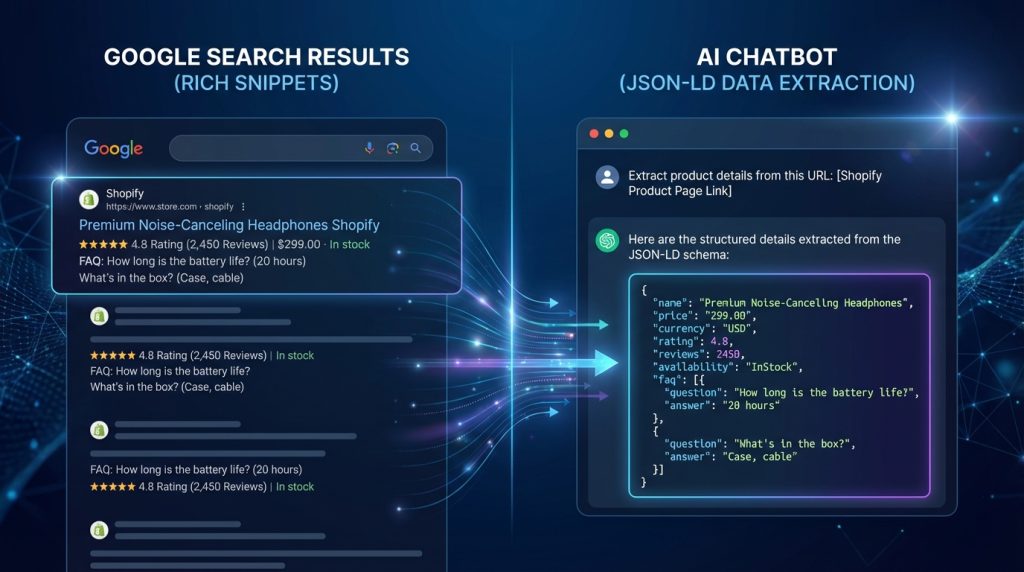
When customers ask:
- “Best B2B wholesale supplier in Europe”
- “Affordable organic baby clothes brand”
- “Reliable Shopify furniture store”
They’re asking ChatGPT, Perplexity, and Gemini.
And here’s the shift most merchants don’t understand:
👉 Structured data is optional for Google visibility.
👉 Structured data is foundational for AI visibility.
If your Shopify store lacks proper schema markup, AI may skip you entirely even if you rank well on Google.
Let’s break this down clearly, practically, and specifically for Shopify.
The Core Shift: Google Displays. AI Extracts.
How Google Uses Structured Data
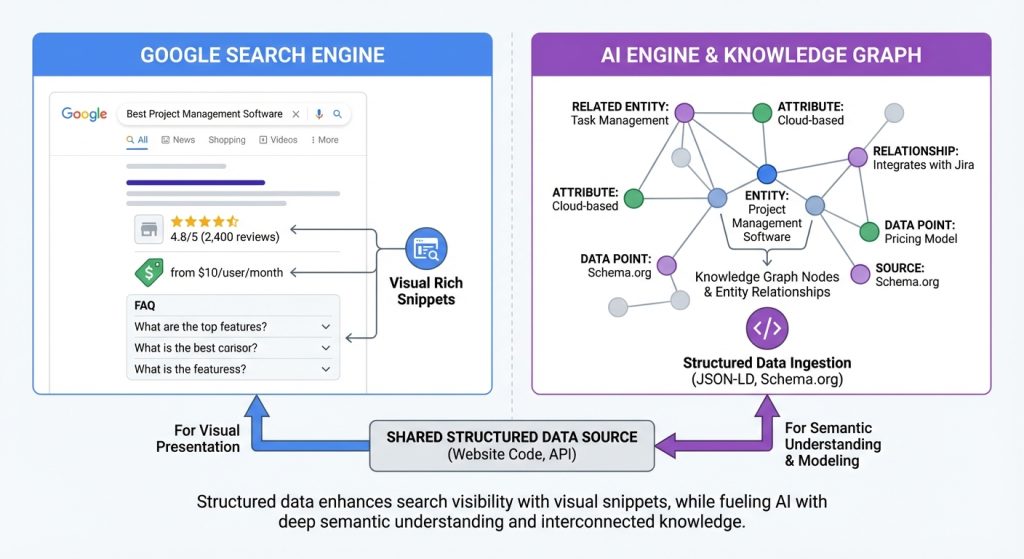
Google primarily uses structured data (Schema.org markup) to:
- Generate rich snippets
- Show star ratings
- Display price & stock
- Enable FAQs under listings
- Create product carousels
Important:
Structured data is not a direct ranking factor.
It improves:
- Click-through rate
- SERP visibility
- Presentation quality
Google still relies heavily on:
- Keywords
- Backlinks
- Page authority
- Content depth
Structured data enhances visibility.
It does not define understanding.
How AI Search Uses Structured Data
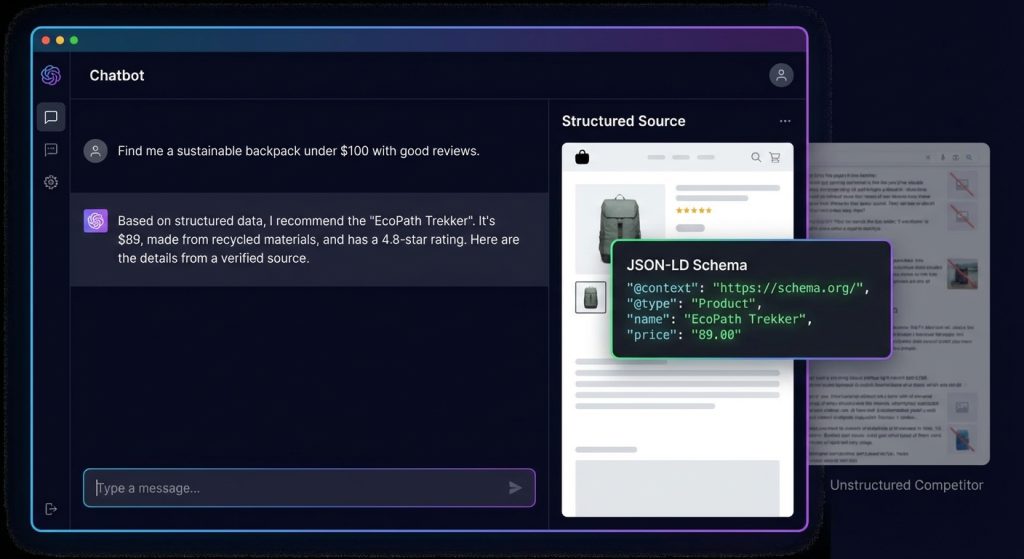
AI search engines treat schema very differently.
They use structured data to:
- Extract factual product data
- Build entity relationships
- Validate source reliability
- Reduce hallucinations
- Score answer confidence
- Construct knowledge graphs
AI systems parse JSON-LD directly to identify:
- Product name
- Brand
- Price
- Availability
- Reviews
- Specifications
- FAQs
- Organization identity
If this data is missing or unclear, AI may:
- Skip your store
- Misinterpret your content
- Pull outdated pricing
- Cite competitors instead
That’s the difference.
Google ranks pages.
AI extracts entities.
Structured Data: Display Enhancement vs Comprehension Engine
| Factor | Google Search | AI Search |
|---|---|---|
| Primary Goal | Ranking & Display | Extraction & Synthesis |
| Schema Role | Visual enhancement | Core comprehension layer |
| JS Handling | Can render JS | Often sees raw HTML only |
| Citation Impact | Indirect | Direct |
| Entity Reliance | Moderate | Critical |
For AI systems, schema is not decoration.
It is infrastructure.
Why This Matters More for Shopify Stores
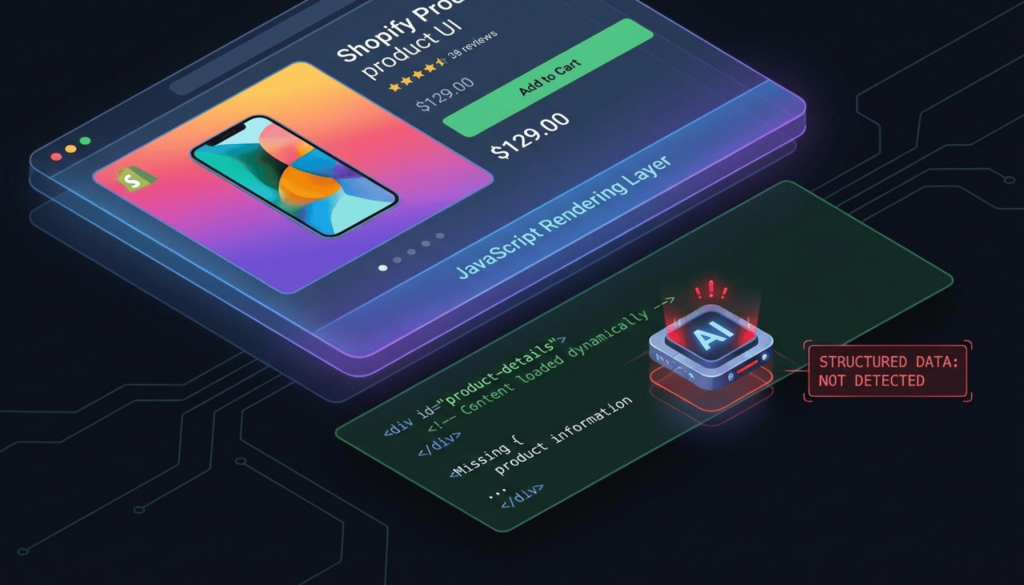
Shopify themes are often:
- JavaScript-heavy
- App-injected
- Client-side rendered
- Dynamic for variants
Google can partially render JavaScript.
Most AI crawlers prioritize raw HTML.
If your structured data:
- Is injected via JS
- Is incomplete
- Is inconsistent
- Does not define variants properly
AI may miss:
- Correct pricing
- Updated inventory
- B2B catalog details
- Regional shipping info
Humans see it.
Google might render it.
AI might not.
Real Impact: Schema Boosts AI Citations More Than Rankings
Benchmarks show structured product pages are cited 2–3x more often in AI results than unstructured ones.
Why?
Because AI:
- Trusts structured data
- Extracts it cleanly
- Scores reliability higher
- Reduces uncertainty
- Prefers defined entities
In AI Overviews and conversational responses, structured sites dominate.
Unstructured pages get skipped.
Shopify-Specific Benefits of Structured Data
1. Product Schema Clarifies Variants
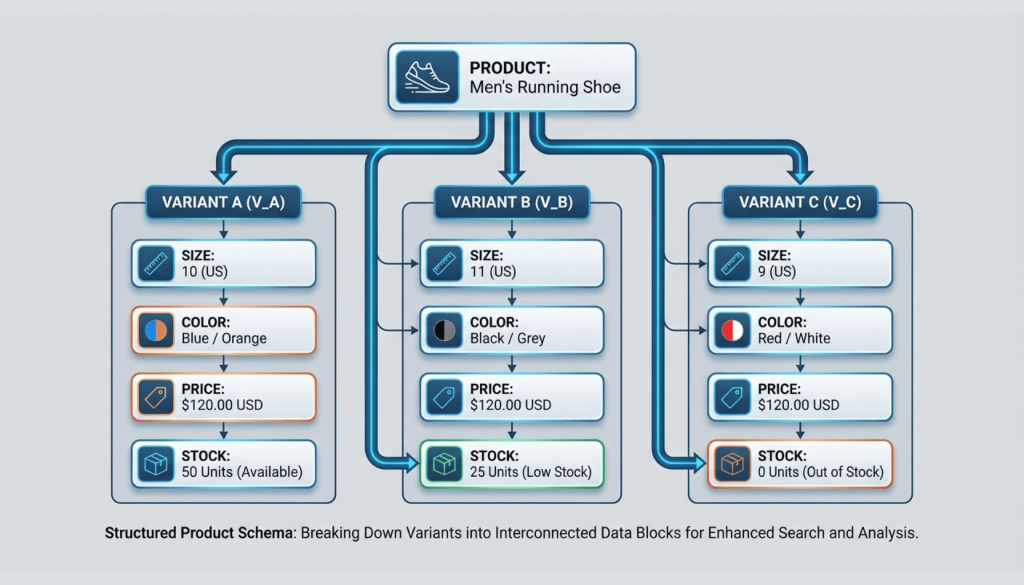
Without proper schema:
AI may not distinguish:
- Size variants
- Color variants
- Regional pricing
- Wholesale pricing tiers
With proper Product schema:
- Variants are clearly defined
- Offers are structured
- Stock levels are reliable
- AI avoids outdated answers
2. FAQ Schema Feeds Conversational AI
AI engines love FAQ markup.
Because:
- It matches conversational queries
- It provides ready-made answer blocks
- It improves extraction confidence
For B2B or wholesale stores in Europe:
Questions like:
- “Do you offer bulk pricing?”
- “What is minimum order quantity?”
- “Do you ship to Germany?”
Structured FAQ markup dramatically increases citation probability.
3. Review Schema Builds Trust Signals
AI engines use:
- Rating values
- Review counts
- Aggregate ratings
To assess brand reliability.
Without structured review schema, your trust signals are invisible to AI.
4. Organization Schema Establishes Identity
AI systems build knowledge graphs.
They want to know:
- Who owns this store?
- Is this a legitimate business?
- Where is it located?
- What markets does it serve?
Organization schema helps AI classify you as a credible source.
The Big Problem: Most Shopify Stores Don’t Implement This Properly
Common mistakes:
- Relying on theme defaults
- Incomplete product schema
- Missing FAQPage markup
- Schema injected via JavaScript only
- No llms.txt guidance
- No SSR embedding
- Variant data not structured
Which means:
Beautiful store.
Invisible AI presence.
How to Fix It (Step-by-Step for Shopify Merchants)
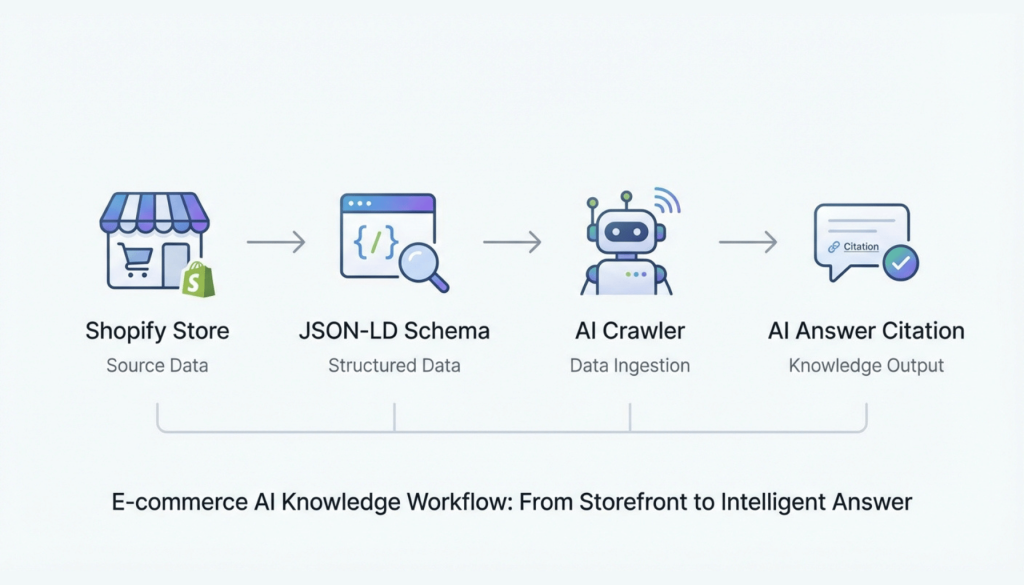
Step 1: Use JSON-LD Format
JSON-LD is preferred because:
- Clean separation from HTML
- Easy parsing by AI
- Less error-prone
- Compatible with Shopify
Avoid microdata or scattered markup.
Step 2: Prioritize These Schema Types
At minimum implement:
- Product
- Offer
- Organization
- FAQPage
- Review
- BreadcrumbList
For B2B stores:
- ItemList
- Catalog
- Service (if applicable)
Step 3: Embed Schema Server-Side (SSR)
Add schema inside theme.liquid or through Shopify apps that inject directly into HTML — not via client-side JS.
Remember:
AI often reads initial HTML only.
Step 4: Validate Properly
Use:
- Google Rich Results Test
- Schema Markup Validator
But don’t stop there.
Test by asking AI:
- “Best [your product] in [your region]”
- “Does [your brand] offer wholesale pricing?”
See if structured details appear.
Step 5: Audit Competitors
Search your niche inside AI tools.
If competitors are being cited consistently:
They likely have better structured entity signals.
Structured stores dominate AI shopping answers.
The Role of llms.txt Alongside Schema
Structured data defines content.
llms.txt defines access and trust.
Together they:
- Guide AI crawlers
- Prevent draft scraping
- Protect unpublished data
- Clarify live inventory
- Improve extraction accuracy
Schema without crawler control is incomplete.
FIX IT IN ONE CLICK
Manual schema setup is:
- Time-consuming
- Error-prone
- Technically complex
- Hard to maintain across large catalogs
FSEO.ai by Final Apps automates:
- Product schema generation
- Variant structure mapping
- FAQ markup
- Organization schema
- llms.txt creation
- AI crawler control
- AEO tracking
- AI visibility performance monitoring
Instead of patching JSON manually,
It systemizes AI readiness across your Shopify store.
Especially useful for:
- B2B catalogs
- European Shopify stores
- High-SKU merchants
- FixMyStore audit clients preparing for BFCM
The New Rule for Shopify SEO
Google SEO optimizes for ranking.
AI SEO optimizes for understanding.
Structured data is optional in Google.
Structured data is foundational in AI.
If AI cannot clearly extract your:
- Products
- Prices
- Variants
- Reviews
- FAQs
- Organization identity
You don’t exist in AI search.
Conclusion
In the AI commerce era:
Structure > Style
Extraction > Keywords
Entities > Density
Clarity > Clever copy
Your Shopify store must now be:
- Human-friendly
- Google-optimized
- AI-structured
Because in AI search:
You don’t rank.
You get selected.
And structured data is how you get selected.