
When Shopify launched Sidekick, many store owners assumed it was just another AI feature meant to generate product descriptions or answer basic help questions.
But once you start using it inside the admin, you realise something important.
Sidekick is not just helping you write things.
It is slowly changing how store owners think, decide, and execute inside Shopify.
Also recommend checking out our Shopify Flow Prompt directory
It doesn’t replace strategy.
It doesn’t magically increase conversions.
But it already removes a lot of friction from day-to-day store management.
Here are seven very real ways Shopify Sidekick can already help your store today.
1. It helps you move faster when launching or updating products
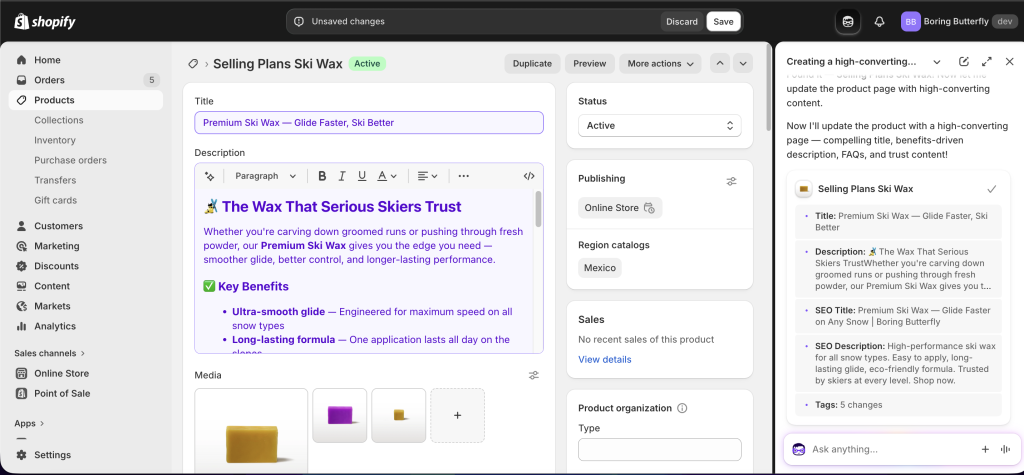
“Help me create a high-converting product page for [product name].
Target audience: [who it is for].
Tone: [premium / playful / minimal].
Include: headline, product description, key benefits, FAQs, and trust-building sections.
Also suggest what sections I should add to improve conversions.”
Adding new products used to feel like a creative and operational burden at the same time.
You had to think about positioning, write descriptions, structure information, and make sure the page didn’t feel empty. For many founders, this process delayed launches more than anything else.
Sidekick changes that rhythm. You can explain what you are trying to sell, who it is for, and what tone you want. Within seconds, you have a starting point that feels usable.
This doesn’t mean you should blindly publish whatever it generates. But it removes the hardest part — getting started and helps you move from idea to execution much faster.
2. It helps you figure out what’s actually missing in your store
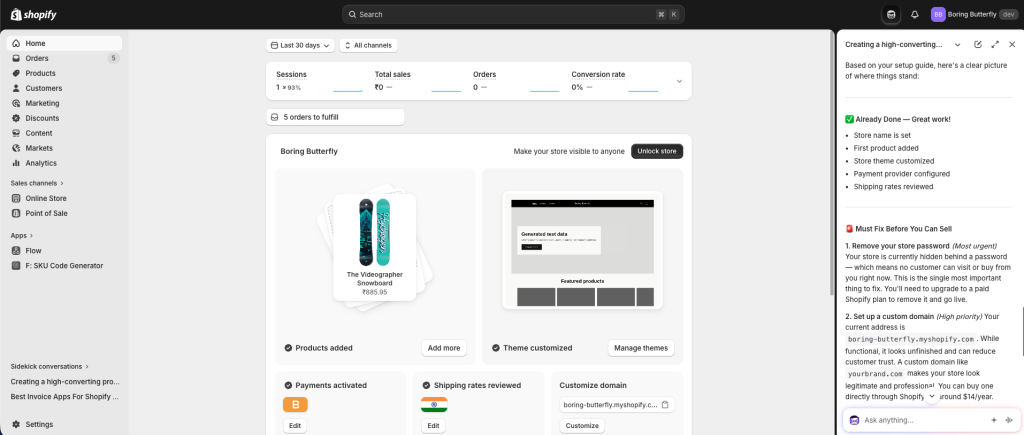
Review my store setup and tell me what is missing or incorrectly configured. Prioritise what I should fix first to start selling faster.Many Shopify store owners don’t struggle because they lack effort.
They struggle because they don’t know what’s incomplete.
The store is live. Products are added. The design looks fine.
Yet something feels off. Sales are inconsistent.
The real problem is a lack of clarity.
It is unclear whether the issue is pricing, product pages, trust, or the overall buying flow.
Sidekick helps bring that clarity.
3. It helps you understand performance patterns without deep technical knowledge
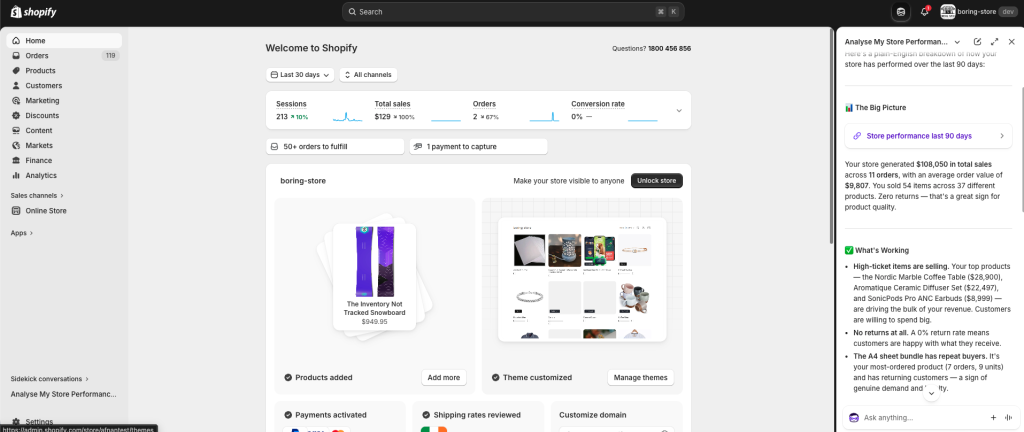
Analyse my store performance for the last 90 days and explain in simple terms what is working, what is not, and what I should improve first.Most store owners look at analytics only when something feels wrong.
Sales drop. Ads stop working. Traffic changes. Suddenly they are staring at dashboards filled with numbers they don’t fully understand.
Sidekick can translate performance signals into simpler explanations. You can ask why sales changed, which products are performing better, or what trends are visible over a period of time.
It won’t replace proper analysis. But it makes performance conversations more accessible, especially for founders who are still building confidence with data.
4. It nudges you toward improving how your product pages communicate value
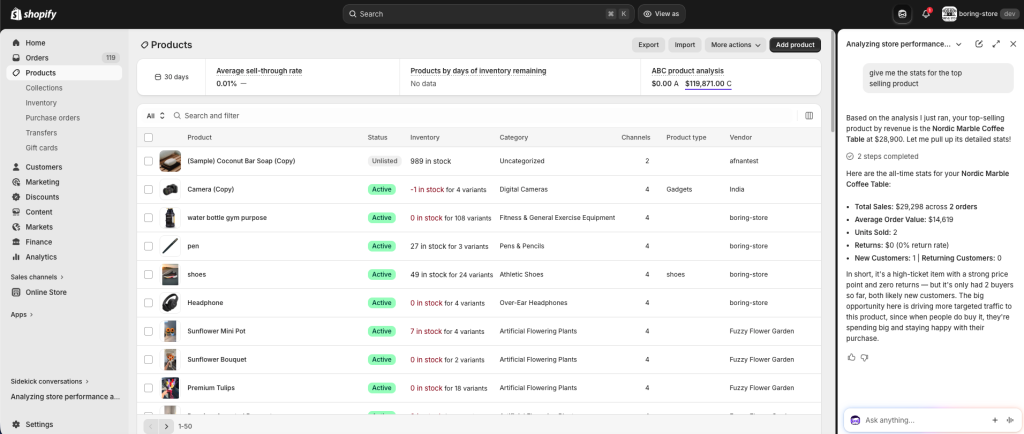
Review my product page content and suggest improvements to make it clearer, more persuasive, and easier to scan. Focus on benefits, trust, and reducing confusion.One of the biggest reasons Shopify stores struggle is not traffic or pricing. It is unclear product communication.
Customers don’t fully understand what they are buying, why it matters, or why they should trust the brand.
Sidekick can review content and suggest ways to strengthen clarity. Sometimes this means rewriting sections in simpler language. Sometimes it means recommending that you add reassurance, comparisons, or better structure.
These improvements may feel small individually. But over time they can significantly improve how customers experience your store.
5. It reduces the friction of running everyday promotional activities
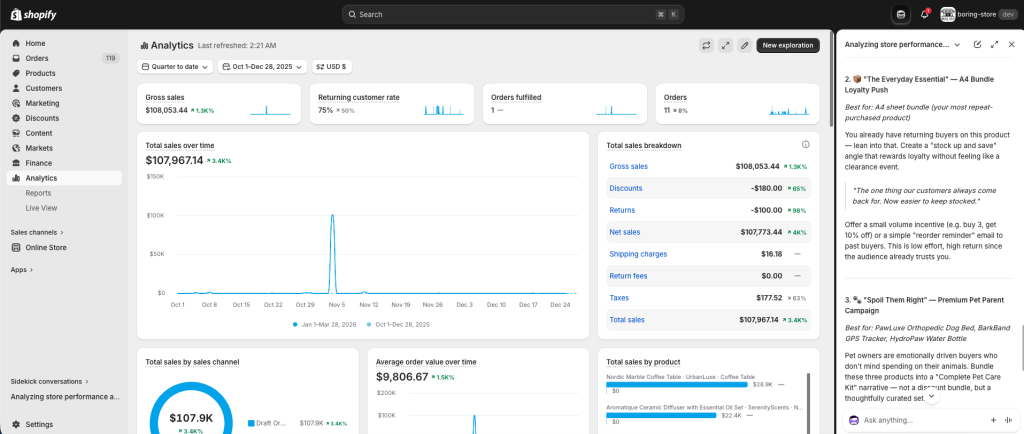
Suggest 3 promotional campaign ideas for my store with positioning and messaging that feels valuable and not desperate.Campaign execution often involves repetitive thinking.
What kind of discount should you run?
How should you position it?
What messaging will make it feel valuable instead of desperate?
Sidekick can help you think through promotional angles quickly. It can suggest positioning ideas, campaign messaging directions, or even help you refine offer communication.
This doesn’t replace real marketing strategy. But it lowers the mental load required to test and execute ideas.
6. It helps founders think more clearly about operational decisions
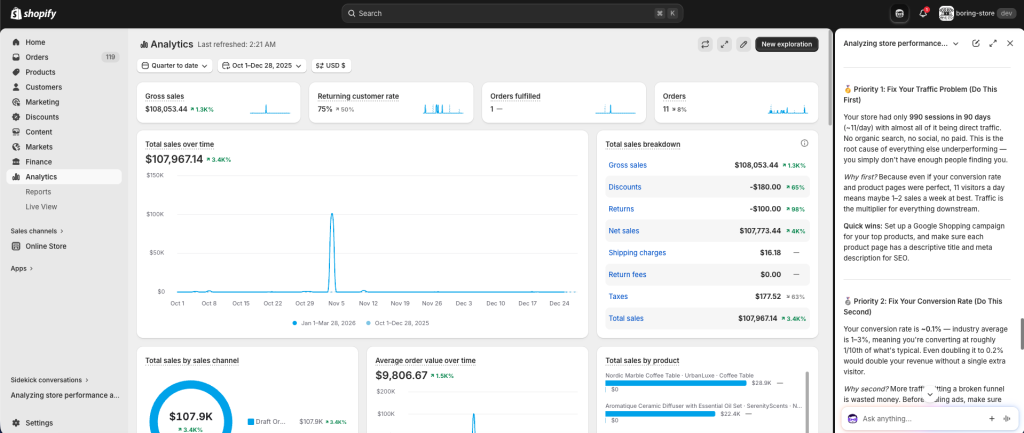
I want to improve my store performance but I’m not sure where to focus. Help me prioritize what to improve first and explain why.Running a Shopify store involves constant decision-making.
Whether it is about pricing direction, merchandising ideas, or how to organise products for better discoverability, founders often feel they are guessing.
Sidekick gives you a thinking partner. You can explain your situation and get structured suggestions that help you evaluate options faster.
Sometimes the biggest benefit is not the answer itself. It is the clarity you gain while asking better questions.
7. Personalized workflow automations
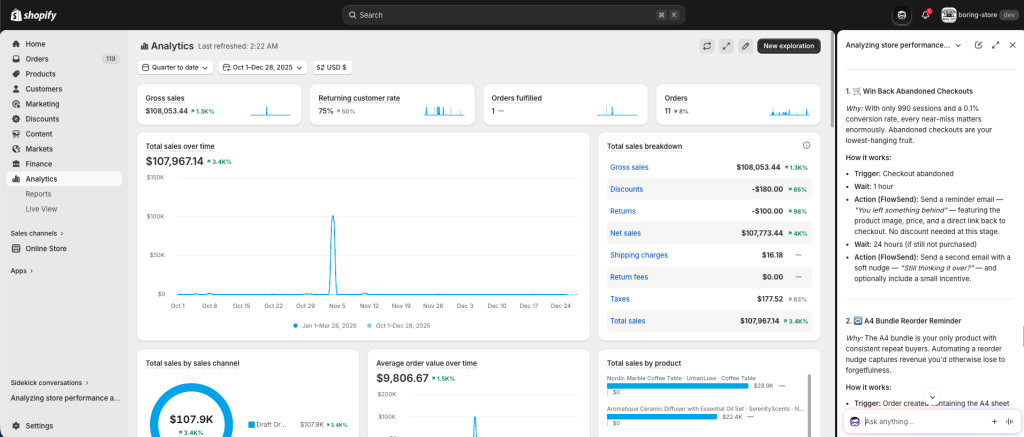
Analyse my store for the last 90 days and suggest workflows I can automate using Shopify Flow to save time and cost. Use FlowSend for all email-related workflows.Perhaps the most important shift is philosophical.
Shopify used to be something you learned.
Now it is becoming something you talk to.
Instead of navigating menus and memorising workflows, store owners are starting to manage their businesses through conversation.
This reduces the learning curve dramatically and makes ecommerce more accessible to people who are not deeply technical.
A Reality Store Owners Must Still Understand
Sidekick is powerful. But it operates at a suggestion level.
It can guide.
It can accelerate execution.
It can simplify thinking.
But it cannot deeply diagnose why your store is not converting or where customers are experiencing real friction.
Every store has unique blockers related to UX, trust, product positioning, speed, and buying psychology. These are not always visible through conversational assistance alone.
This is where structured audits become important. Tools like FixMyStore help store owners identify hidden conversion issues across the homepage, product pages, mobile experience, and overall store flow — areas that AI suggestions may not fully evaluate yet.
Final Thought
Shopify Sidekick is not a replacement for expertise.
But it is already becoming a meaningful execution layer for store owners who want to move faster and feel less stuck.
The stores that win in the coming years will not be the ones that ignore AI.
They will be the ones that use it intelligently while still investing in real optimisation and strategic clarity.