
Shopping is changing faster than ever. Instead of browsing websites, your customers are now asking ChatGPT “find me a waterproof backpack under $80” and completing their purchase without leaving the chat. This isn’t science fiction! It’s happening right now, and Shopify calls it agentic commerce.
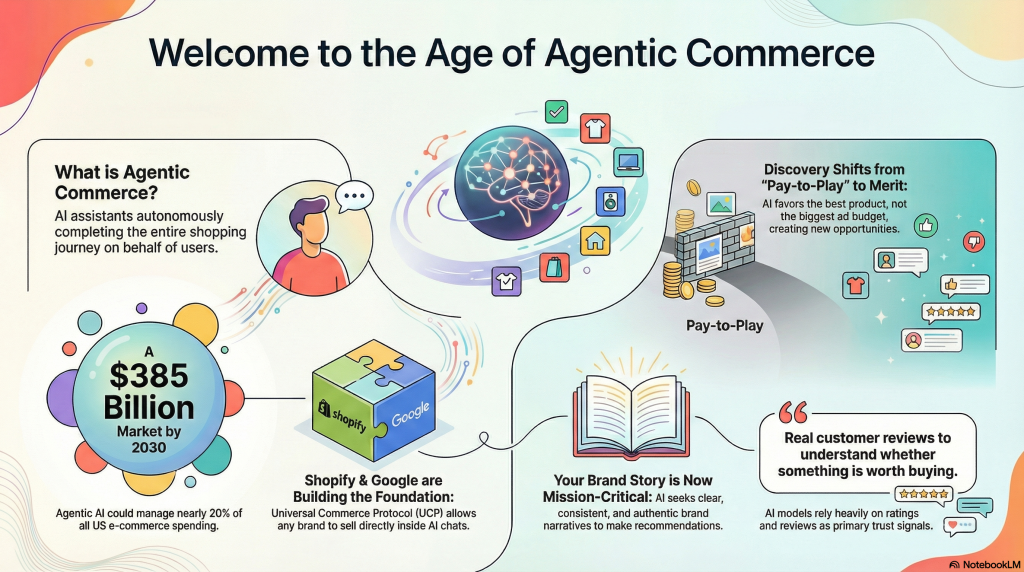
In January 2026, Shopify partnered with Google and Microsoft to launch the Universal Commerce Protocol (UCP), making it possible for AI agents to shop across millions of stores. If you’re a Shopify merchant, this represents the biggest opportunity since mobile commerce, but only if you act now while competition is still low.
This guide will show you exactly What agentic commerce is, How it works, and most importantly;
How to set it up for your store today.
What is Shopify Agentic Commerce ?
Agentic commerce is when AI assistants like ChatGPT, Google Gemini, or Microsoft Copilot handle shopping tasks for customers. Instead of clicking through product pages, customers simply tell the AI what they need, and it searches, compares, and even completes the purchase on their behalf.

Think about how you shop now. You probably open multiple browser tabs, compare prices, read reviews, check shipping costs, and bounce between stores. It takes time and mental energy. With agentic commerce, you skip all that. You tell an AI agent what you want, and it does the work while you focus on other things.
Here’s a real example: A customer tells Google Gemini “I need organic dog food for a 50 pound dog with sensitive stomach, budget $50.” Gemini searches Shopify’s catalog of millions of products, filters by requirements, compares options from different stores, adds the best match to cart, and presents checkout – all in one conversation.
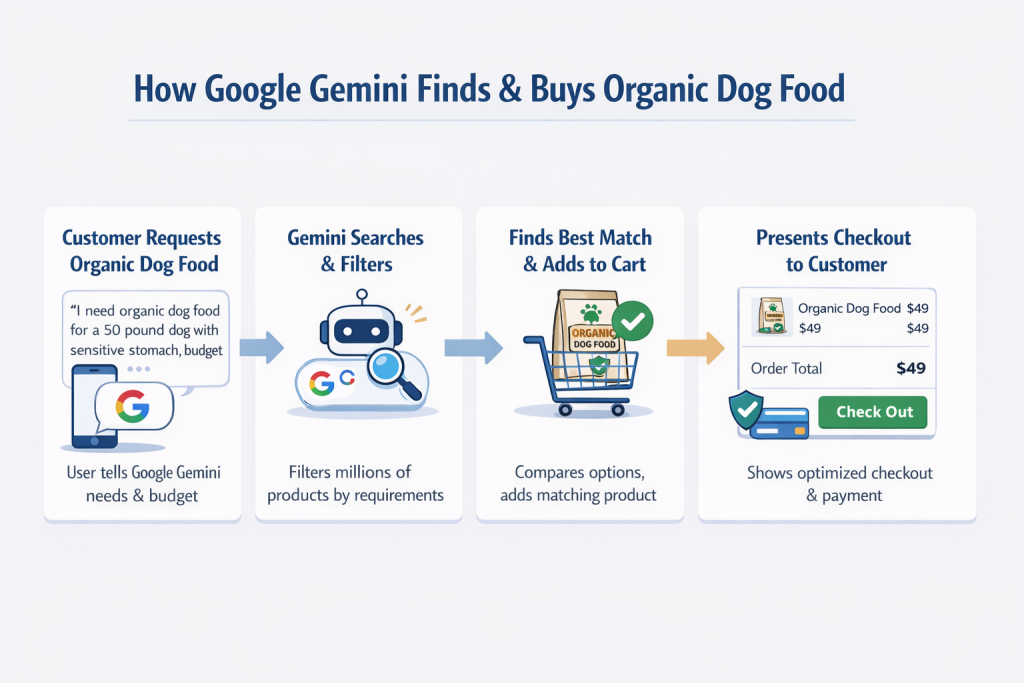
The key difference from regular chatbots? Agentic AI doesn’t just answer questions. It takes action. It can browse catalogs, manage shopping carts across multiple stores, apply discount codes, and complete secure checkouts without human intervention.
Why This Matters for Your Shopify Store
Shopify President Harley Finkelstein revealed something remarkable at the National Retail Federation conference in January 2026: AI driven orders to Shopify stores increased 14 times in just 12 months. The base is still small, but it’s growing exponentially – similar to how mobile shopping started small in 2010 and now dominates retail.
Morgan Stanley predicts that AI shopping could capture between $190 billion and $385 billion of US
e-commerce spending by 2030. That’s 10 to 20 percent of all online shopping.
More importantly, this traffic is merit based, not ad based. Finkelstein explained that AI agents recommend products based on quality and relevance, not who paid for advertising. This levels the playing field for small merchants who can’t compete with big brands’ advertising budgets but have great products.
That’s democracy in commerce: the best product wins, not the biggest ad budget.
How Shopify Agentic Commerce Actually Works
Let me walk you through the complete customer journey so you understand what happens behind the scenes.
Step 1: Customer Tells AI What They Need
Sarah opens ChatGPT and types: “Find me a minimalist leather wallet under $50 that fits in small purses.” The AI understands this is a shopping request and activates commerce capabilities.
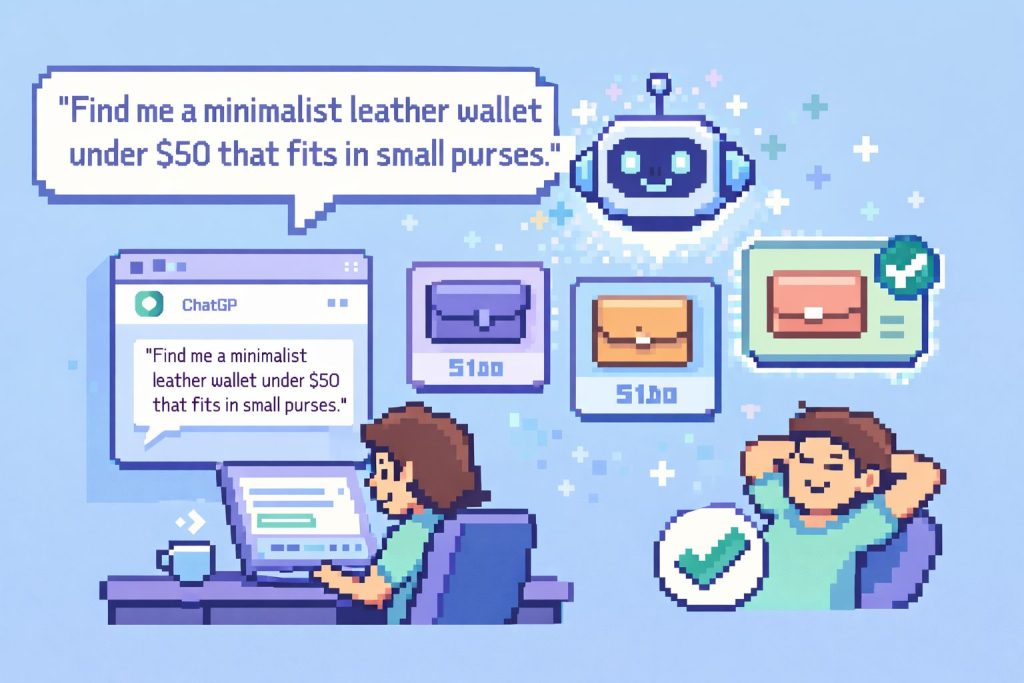
Step 2: AI Searches Shopify’s Global Catalog
ChatGPT queries Shopify’s Catalog API, which has access to hundreds of millions of products from Shopify merchants worldwide. The search uses natural language processing (NLP) to understand “minimalist,” “leather,” “small purses,” and the $50 budget constraint.
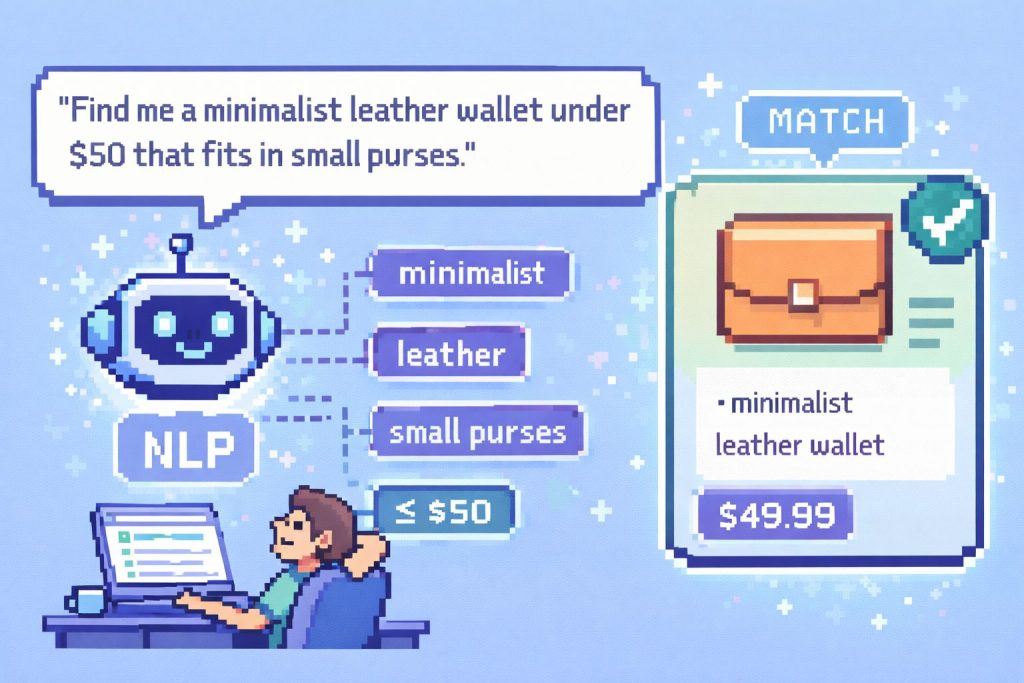
Step 3: AI Filters and Compares Options
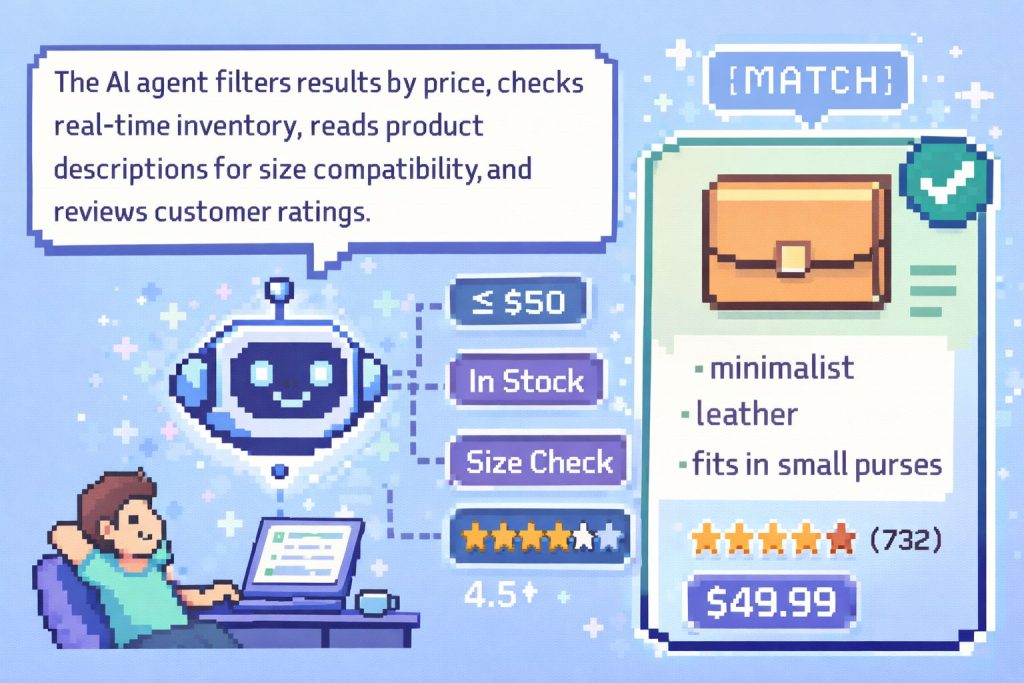
The AI agent filters results by price, checks real-time inventory, reads product descriptions for size compatibility, and reviews customer ratings. It might compare options from three different Shopify stores, adding the best candidates to a Universal Cart that holds items from multiple merchants.
Step 4: AI Presents Recommendations
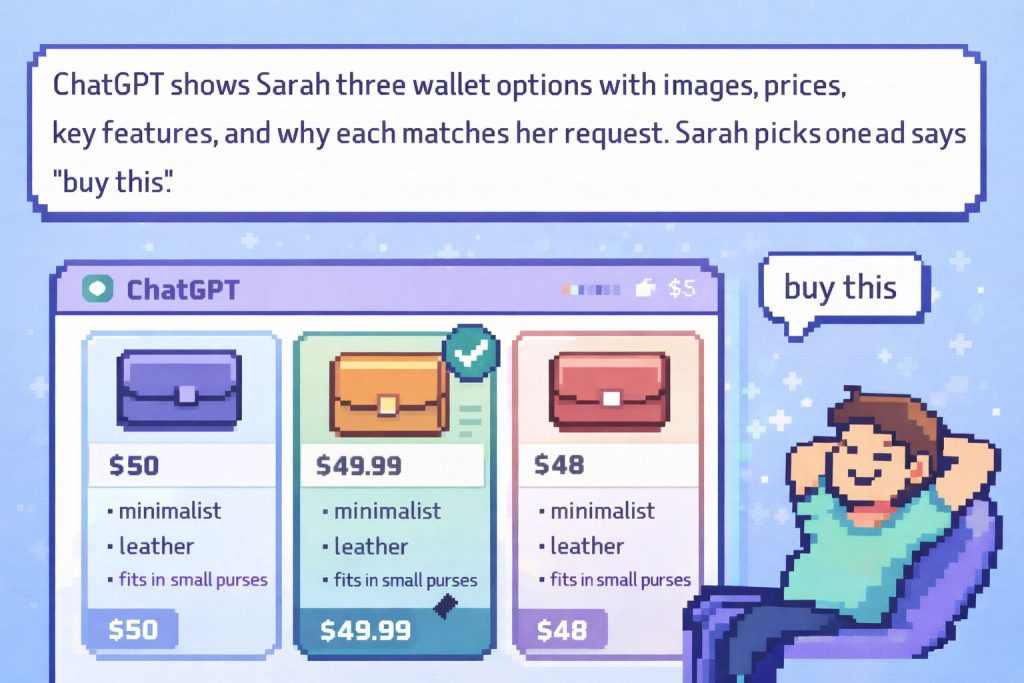
ChatGPT shows Sarah three wallet options with images, prices, key features, and why each matches her request. Sarah picks one and says “buy this”.
Step 5: Secure Checkout Without Leaving Chat
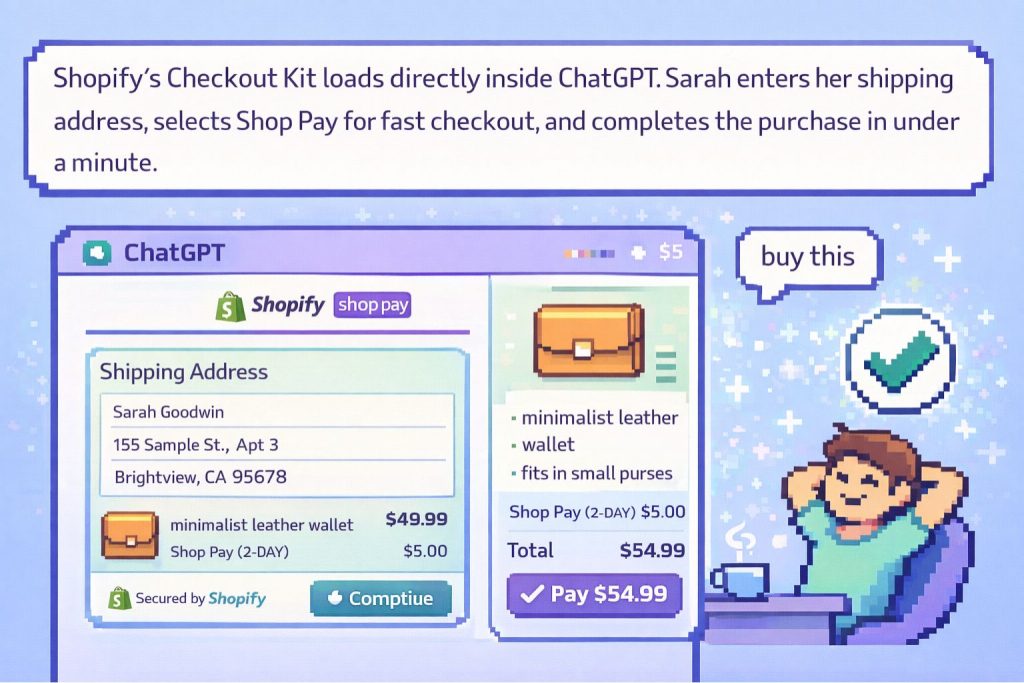
Instead of redirecting to a website, Shopify’s Checkout Kit loads directly inside ChatGPT. Sarah enters her shipping address, selects Shop Pay for fast checkout, and completes the purchase in under a minute.
Step 6: Order Goes to Your Shopify Dashboard
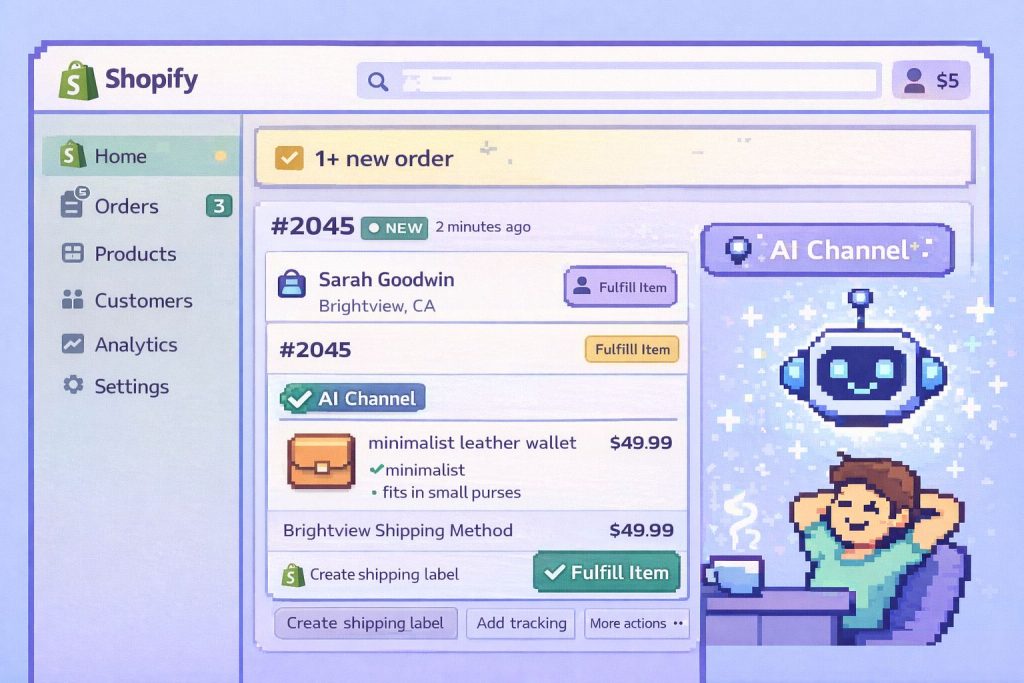
You receive the order exactly like any other sale. It appears in your Shopify admin with a label showing it came from an AI channel. You fulfill it normally using your existing workflow.
The entire process happens in one conversation, never requiring the customer to open a web browser or visit your website.
The Technology Behind It: Universal Commerce Protocol
The Universal Commerce Protocol (UCP) is the technical foundation that makes all this possible. Before UCP, every AI platform needed custom integrations with every e-commerce system. If there are 10 AI platforms and 100 e-commerce systems, that’s 1,000 separate integrations to build and maintain.
Google and Shopify solved this problem together by creating an open standard that any AI agent can use to shop at any store. Target, Walmart, Etsy, Wayfair, and over 20 other major retailers have adopted UCP since its January 2026 launch.
The Three Core Components
Shopify Catalog API
This gives AI agents instant access to product information from millions of Shopify stores. It provides real time inventory levels, localized pricing based on customer location, high quality product images, detailed descriptions, customer reviews, and variant options like sizes and colors.
Shopify also uses smart clustering technology to group identical products sold by different merchants, reducing duplicate results and improving search relevance.
Universal Cart
One of the biggest technical challenges is managing shopping carts that contain items from multiple different stores. Shopify’s Universal Cart solves this by creating a single unified cart that works across merchants.
This means a customer can add a tent from Store A, a sleeping bag from Store B, and camping cookware from Store C – all in one AI conversation, then check out once for everything. For merchants, this increases the likelihood of multi item sales even when customers are comparison shopping.
Checkout Kit
The Checkout Kit embeds Shopify’s secure, high converting checkout flow directly inside AI platforms. It handles payment processing, shipping calculations, discount codes, gift cards, and order confirmation emails automatically.
Critically, it manages compliance with GDPR, PCI DSS, and other regulations, removing major legal hurdles for merchants. You don’t need to worry about payment security or data privacy, shopify handles it using the same infrastructure that processes billions in transactions annually.
- UCP uses a smart capabilities system where your store tells AI agents what features you support. For example, if you offer gift wrapping, local pickup, or subscription products, AI agents can query these capabilities before presenting options to customers.
- This accommodates real world complexity where every store is different. Some stores ship internationally, others don’t. Some offer returns, others have final sale policies.
UCP handles all these variations gracefully.
How to Set Up Agentic Commerce for Your Shopify Store
Let’s get practical. Here’s exactly how to enable agentic commerce and optimize your store for AI discovery.
Step 1: Enable the Agentic Storefront
As of January 2026, Shopify is rolling out agentic storefronts in phases. If your store is eligible, you’ll see a new sales channel setting in your Shopify admin.
Navigate to Settings > Sales Channels in your admin panel. Look for "Agentic Storefront" or "AI Shopping Channels" (the exact name may vary during rollout). Toggle it to "Enabled".
When enabled, your products can be purchased directly inside AI platforms like ChatGPT with embedded checkout. When disabled, products remain discoverable in AI search but redirect customers to your online store for checkout completion.
Step 2: Control Which Products Appear in AI Shopping
You don’t have to make all products available through agentic commerce. In your Shopify admin, go to each product page and manage availability under “Sales channels and apps”.
Uncheck “Agentic Storefront” for any product you want to exclude from direct AI purchases. The product will still be discoverable but won’t offer one click AI checkout.
To completely hide products from AI discovery (not recommended for most cases), you can set products as “Unlisted” in your SEO settings, though this also affects traditional search engine visibility.
Step 3: Verify Real-Time Inventory Syncing
AI agents rely on accurate, real-time inventory data. If your inventory shows 5 units available but you’re actually sold out, the AI will recommend an unavailable product and frustrate customers.
Ensure your inventory management system syncs automatically with Shopify. Test this by making a purchase and verifying inventory decrements immediately. If you use third-party fulfillment or multiple warehouses, confirm those integrations update Shopify in real-time.
Step 4: Review Orders from AI Channels
After enabling agentic commerce, check your Shopify admin regularly for AI-sourced orders. Shopify labels these orders with their source channel, allowing you to filter and analyze performance.
Track metrics like conversion rate, average order value, and return rate for AI channel orders compared to traditional website orders. This data will help you optimize your approach over time.
Product Data Optimization: The Foundation of Success
Here’s the truth that most merchants miss: In agentic commerce, your product data quality directly determines whether AI agents find and recommend your products.
Traditional SEO focused on keywords for Google search. Agentic commerce requires something deeper comprehensive, structured product information that AI agents can understand and filter through natural language queries.
1. Write Descriptions Like You’re Talking to a Friend
AI agents process natural language, so write product descriptions the way customers actually speak.
Bad description: “Premium jacket. Multiple colors available.”
Good description: “Waterproof insulated winter jacket with breathable Gore-Tex fabric, perfect for hiking and outdoor activities in temperatures down to -20°C. Features adjustable hood, zippered pockets, and reflective strips for visibility. Machine washable. Available in black, navy, and forest green in sizes XS through XXL.”
The good description includes specific features, use cases, temperature ratings, care instructions, and complete variant information. This gives AI agents detailed attributes to match against customer queries.
2. Implement Comprehensive Tagging
Tags are the metadata that enables accurate filtering. Think about every question a customer might ask about your product, then create tags that answer those questions.
For food products: vegan, gluten-free, organic, non-GMO, dairy-free, keto-friendly, nut-free, kosher, halal
For clothing: machine-washable, wrinkle-resistant, breathable, moisture-wicking, stretchy, petite-sizing, plus-size, sustainable
For electronics: compatible-with-iPhone-15, USB-C-charging, wireless-capable, water-resistant, battery-powered
The more specific your tags, the better AI agents can filter results to match exact customer requirements.
3. Use High Quality Images and Videos
AI agents process visual content alongside text descriptions. Upload high resolution images from multiple angles: front, back, side, top, detail shots of important features, and lifestyle images showing products in use.
Videos demonstrating how products work provide additional context that helps AI agents understand use cases and make better recommendations.
4. Keep Pricing and Variants Accurate
Ensure all product variants (sizes, colors, styles) are properly configured with accurate pricing. Double check that sale prices display correctly and that price rules apply properly for different customer segments or regions.
Inaccurate variant data leads to situations where AI agents recommend products that don’t exist in the size or color the customer wants, killing the sale.
5. Maintain Rich Product Specifications
Add detailed specifications using Shopify’s product metafields. Include dimensions, weight, materials, country of origin, care instructions, warranty information, and compatibility details.
For example, if you sell phone cases, specify exact device compatibility: “Fits iPhone 15 Pro Max only. Not compatible with iPhone 15 Pro or other models.” This prevents returns from customers who ordered the wrong product.
Real Examples of Agentic Commerce in Action
Let me show you how this works in the real world with actual use cases.
Google Gemini’s Automated Purchasing
Google Gemini now offers conditional automated buying. A customer can tell Gemini: “Buy me a 5 pound bag of Blue Buffalo dog food when it drops below $25” or “Order my regular coffee when I have 3 days of supply left based on my consumption pattern”.
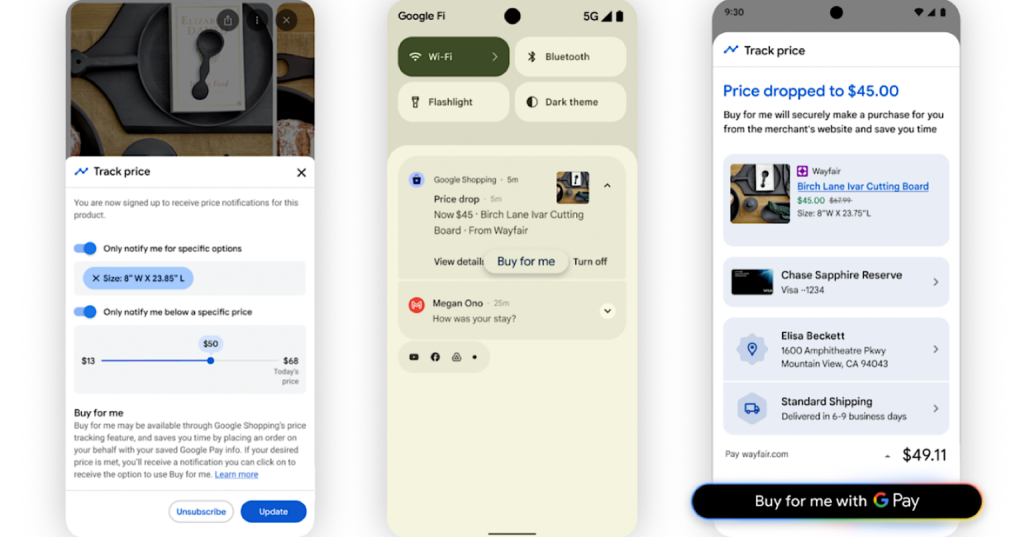
Gemini monitors prices and inventory, then completes the purchase automatically using Google Pay when conditions are met. The customer never has to think about it – the AI handles routine replenishment purchases while they focus on other things.
Physical Store Inventory Checking
Gemini can now call physical retail locations using enhanced Duplex technology to verify stock availability. If a customer asks “Does the Nike store in downtown Seattle have Air Max 90s in size 11?”, Gemini can call the store, speak with staff, confirm availability, and report back to the customer.

This bridges online and offline retail, reducing frustration during high demand periods when online inventory doesn’t reflect store availability.
Multi-Store Shopping Sessions
A customer planning a camping trip tells ChatGPT what they need. ChatGPT adds a tent from REI, a sleeping bag from Patagonia, and camping cookware from Snow Peak – all different Shopify merchants into one Universal Cart. The customer reviews everything together and checks out once, while each merchant receives their respective order.
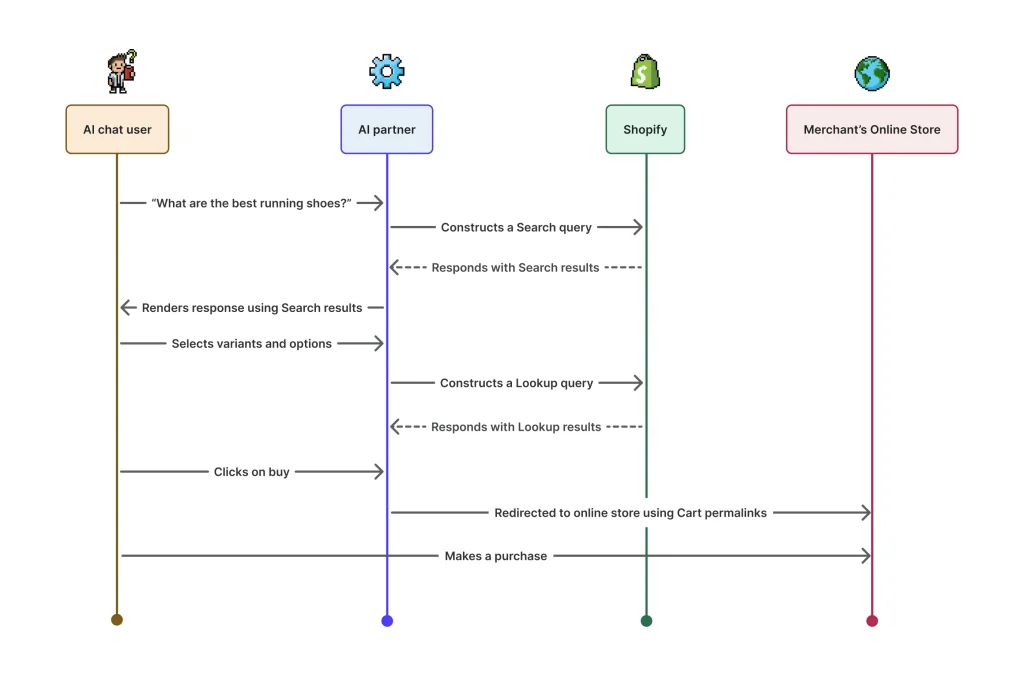
This was impossible before UCP because each store required separate checkout processes. Now AI agents orchestrate complex multi-merchant purchases seamlessly.
Merit-Based Discovery for Small Brands
Tom Sachs runs ‘NikeCraft’, a niche sneaker line for “entrepreneurs who just want to hang out,” not athletes. He doesn’t have budget for Google Ads or SEO optimization, so he’s invisible in traditional search.

But when an AI agent knows a customer likes limited-edition streetwear, architectural design, and niche brands like Kith and Supreme, it recommends ‘NikeCraft’ sneakers based on relevance – not advertising budget. This merit based discovery helps small, quality focused brands compete against companies with massive marketing budgets.
Understanding the Business Impact
Beyond the technology, let’s talk about what this means for your revenue and growth strategy.
New Customer Acquisition Channel
Agentic commerce represents an entirely new traffic source beyond Google search, social media ads, and marketplace listings. You’re now discoverable to the millions of daily active users on ChatGPT, Gemini, and Microsoft Copilot.
A KPMG survey from late 2025 found that 78 percent of Canadians are likely to use AI before choosing where to shop. This behavior shift creates opportunity for early movers who optimize now while competition is still low.
Reduced Customer Acquisition Costs
By appearing in AI recommendations organically through well-optimized product data, you can reduce dependency on paid advertising. Clean, comprehensive product information improves discoverability without ongoing ad spend.
Think of it as the new SEO, except instead of optimizing for Google’s algorithm, you’re optimizing for AI agent logic.
Higher-Intent Customers
Customers using AI agents for shopping often have higher purchase intent because they’ve already articulated specific needs. They’re not browsing casually! they’re actively looking to buy something that meets defined criteria.
This can lead to higher conversion rates compared to broad search traffic where many visitors are just researching or comparing options without immediate purchase intent.
E-Commerce Won’t Disappear
Some merchants worry that agentic commerce will make their websites obsolete. Shopify President Harley Finkelstein addressed this directly at NRF 2026.
Your online store remains your hub – where you display videos and content, collect newsletter signups, announce product drops, and tell your brand story. Agentic commerce is a new spoke, not a replacement.
In fact, some analysts believe AI shopping will increase overall e-commerce penetration because people currently using ChatGPT for recipes or travel planning will discover they can also buy products without leaving the app. E-commerce as a percentage of total retail is still under 20 percent in the US, leaving massive room for growth.
Common Challenges and How to Solve Them
Let’s address the practical obstacles you might face and how to overcome them.
Challenge 1: My Product Data is Messy
Most stores have inconsistent descriptions, incomplete tags, and missing specifications. This happens gradually over time as different people add products without following standards.
Solution: Conduct a product data audit. Export your entire catalog to a spreadsheet, review each product for completeness, and create a standardization template. Assign someone on your team to own data quality going forward. This is tedious work, but it’s the foundation of agentic success.
Challenge 2: I’m Worried About Privacy and Compliance
You’re right to be concerned about GDPR, PCI DSS, and data handling in AI contexts. These regulations carry serious penalties for violations.
Solution: Shopify’s Checkout Kit handles compliance automatically. When customers check out through AI platforms using Shopify’s embedded checkout, all payment processing and data handling follows Shopify’s existing compliance infrastructure that already processes billions in transactions securely.
You remain the merchant of record with full control over customer data, and you’re not responsible for how AI platforms handle conversational data outside the checkout flow.
Challenge 3: Different AI Platforms Have Different Capabilities
ChatGPT, Gemini, and Microsoft Copilot each have slightly different features and limitations. Managing multiple integrations sounds complicated.
Solution: This is where UCP’s capabilities based model shines. Instead of building separate integrations for each platform, you simply expose what your store can do – like gift wrapping, subscriptions, or local pickup. Each AI agent queries these capabilities and adjusts its behavior accordingly.
If a platform doesn’t support a specific feature your store offers, the AI gracefully handles it by either hiding that option or providing appropriate fallback behavior.
Challenge 4: I Can’t Track AI Performance Like Website Analytics
Traditional analytics tools show page views, click-through rates, and conversion funnels. Agentic commerce works differently because decision-making happens inside opaque AI conversations.
Solution: Shopify labels orders with their source channel in your admin. Filter orders by AI channels to analyze metrics like total revenue, average order value, product popularity, and geographic distribution.
Over time, track trends like whether AI customers have higher lifetime value or lower return rates compared to traditional website customers. This data will help you refine your product data optimization strategy.
What’s Coming Next in Agentic Commerce
The agentic commerce space is evolving rapidly. Here’s what to watch for in 2026 and beyond.
Shopify’s New Agentic Plan
Shopify announced a new pricing plan that allows brands not currently using Shopify for their main
e-commerce operations to access Shopify’s agentic infrastructure. This means even if you sell on another platform, you can list products in Shopify’s Catalog and sell through AI channels powered by Shopify’s Universal Commerce Protocol.
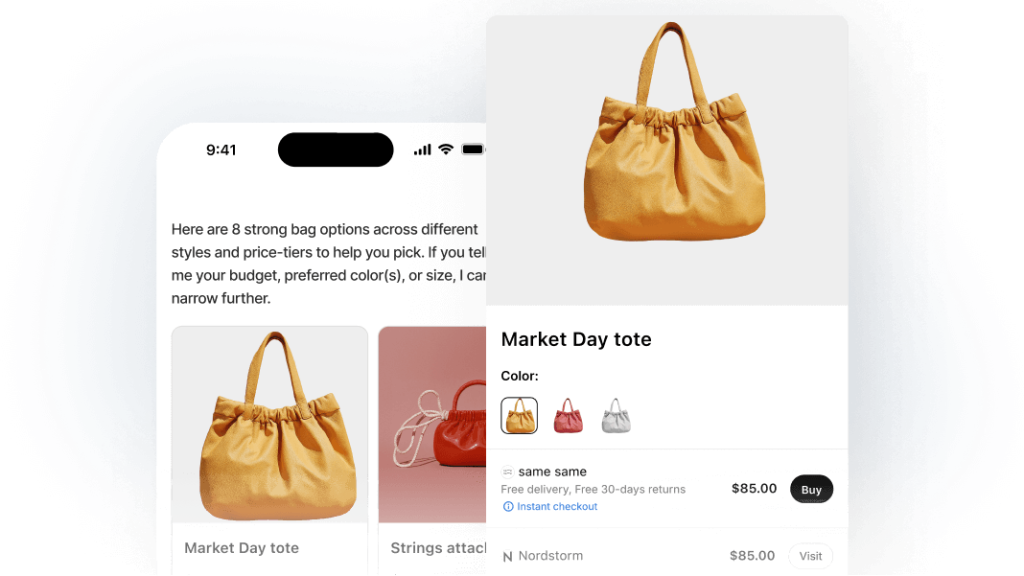
This signals Shopify’s ambition to power agentic commerce industry wide, not just for current customers.
Expanded Platform Partnerships
Shopify is rapidly partnering with major AI platforms. After ChatGPT integration in September 2025, they added native shopping on Google Search and Gemini in January 2026, plus updated Microsoft Copilot Checkout integration.
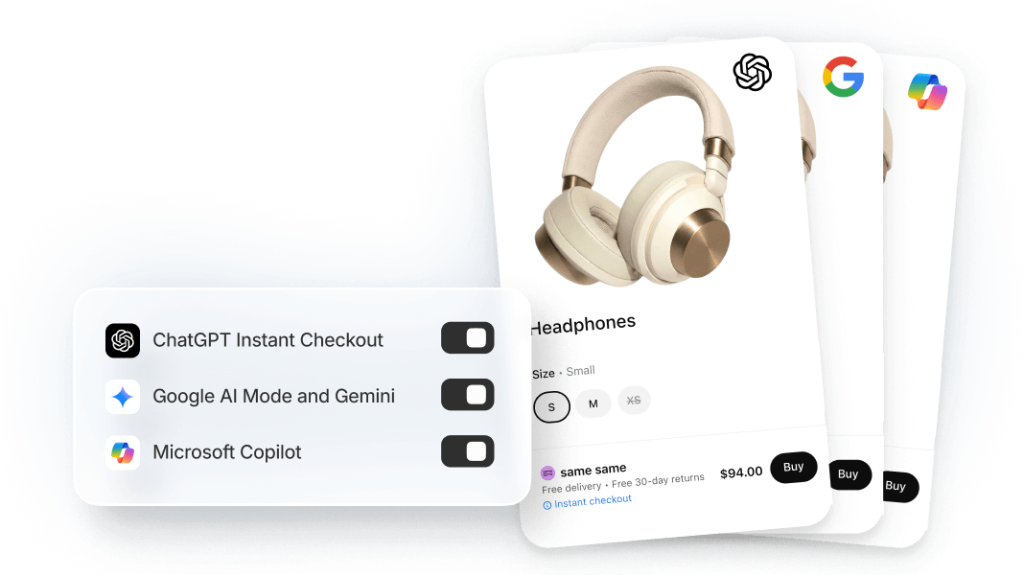
Expect more AI platforms to integrate with Shopify’s UCP throughout 2026, expanding the reach of agentic commerce to wherever customers are having AI conversations.
Increasing Consumer Adoption
Daily active users of AI platforms are growing exponentially, far faster than social media adoption curves. As more people discover they can complete purchases inside ChatGPT or Gemini without opening browsers, this behavior will normalize quickly.
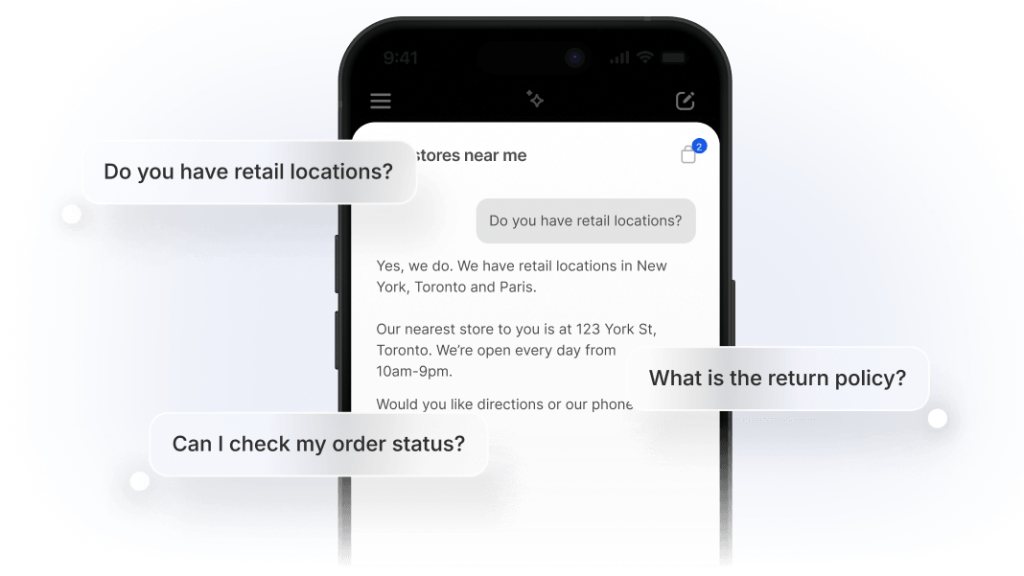
The merchants who optimize now will capture disproportionate early traffic before the channel becomes saturated with competition.
Action Steps: What to Do Today
If you’ve read this far, you understand why agentic commerce matters. Here’s your practical action plan to implement today:
- Enable agentic storefront in your Shopify admin if the option is available for your account
- Audit your top 20 products and rewrite descriptions using natural language that describes features, use cases, and specifications comprehensively
- Add detailed tags covering all attributes customers might filter by (materials, compatibility, dietary restrictions, care instructions)
- Upload high-quality images from multiple angles and add product videos where possible
- Verify real-time inventory syncing to ensure AI agents always see accurate stock levels
- Monitor AI channel orders in your Shopify admin and track performance over time
- Stay informed about new AI shopping platform integrations and features as they launch throughout 2026
The shift to agentic commerce is happening now. Shopify has built the infrastructure. Google, Microsoft, and OpenAI are bringing millions of users. The only question is whether your store is ready to be discovered when those customers ask AI agents for product recommendations.
Frequently Asked Questions
About This Guide: This article was last updated January 19, 2026, and reflects the latest developments in Shopify agentic commerce including the Universal Commerce Protocol launch, Google and Microsoft partnerships, and current implementation practices. As this technology evolves rapidly, check Shopify’s developer documentation for the most recent API specifications and feature availability.