
Most Shopify store owners optimize for humans and Google.
But in 2026, shoppers aren’t just searching on Google.

They’re asking:
- “Best organic baby clothes under ₹2000”
- “Reliable furniture brand in Delhi”
- “Which Shopify app improves checkout conversion?”
And the answers come from LLMs (Large Language Models) like ChatGPT, Gemini, and Perplexity.
Here’s the problem:
👉 What humans see on your Shopify store is not what LLMs see.
And that gap is why most Shopify stores are invisible inside AI search.
The Core Difference: Humans vs LLMs
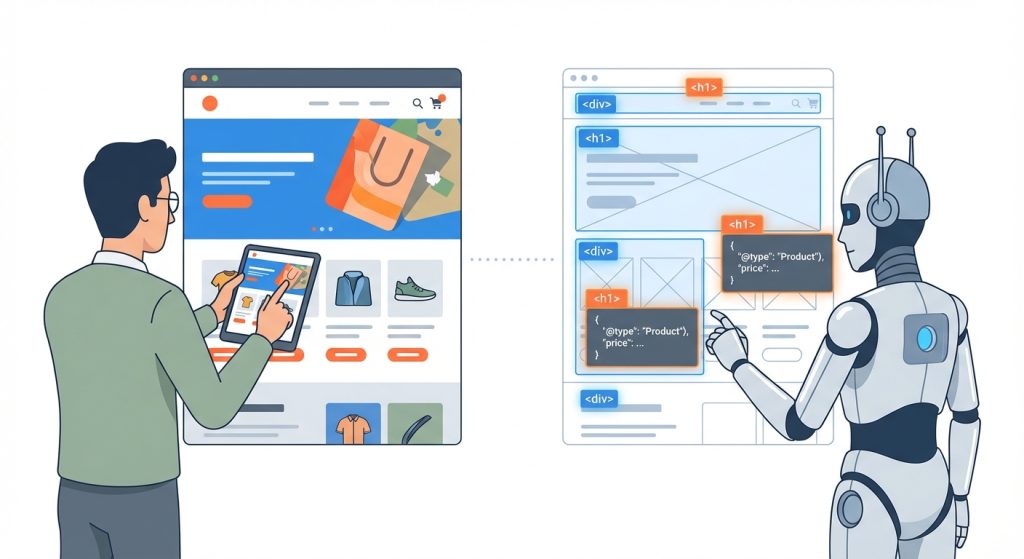
What Humans See:
- Fully rendered page
- Beautiful theme
- JavaScript interactions
- Dynamic pricing updates
- Dropdown variants
- Tabs and accordions
- Popups and sliders
What LLMs See:
- Raw server-side HTML
- Semantic structure (H1, H2, lists)
- Schema.org JSON-LD
- Crawlable text blocks
- Clean structured content
They ignore or strip:
- Most JavaScript-rendered content
- Client-side injected pricing
- Dynamic variant selectors
- Sliders & hidden tabs
- Navigation clutter
- Code comments (sometimes exposed if messy)
So while your store looks perfect to users…
An LLM might see:
- No proper product description
- No visible pricing
- No structured entity signals
- No FAQ structure
- No schema markup
- No crawler guidance
That’s the visibility gap.
LLM Processing Gaps in Shopify Themes
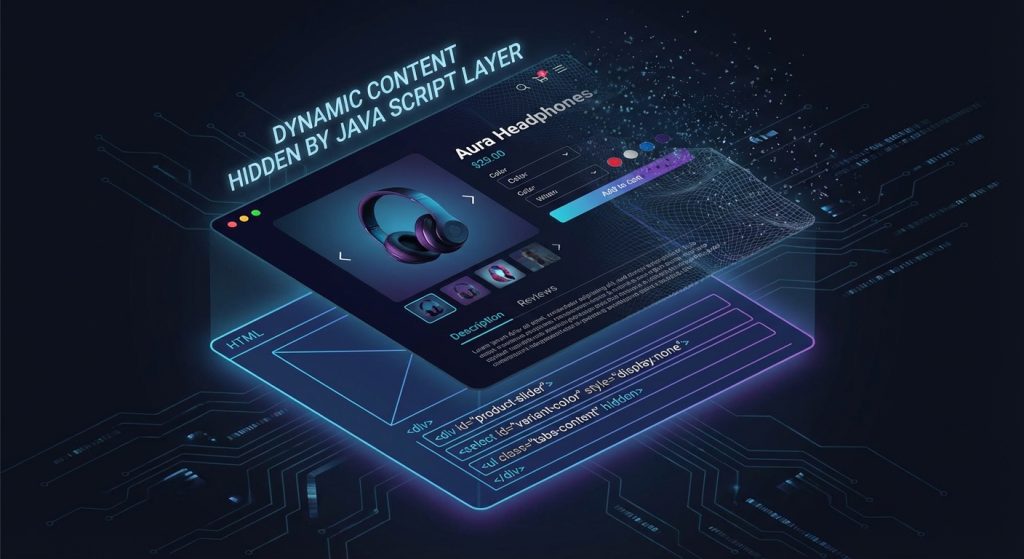
Many modern Shopify themes are JS-heavy.
They rely on:
- Client-side rendering
- App-injected widgets
- Dynamic pricing scripts
- Variant rendering through JavaScript
Humans see everything.
But LLM crawlers typically prioritize:
- Initial HTML response
- Server-rendered content
- Structured markup
If your:
- Product name
- Price
- Inventory
- Reviews
- FAQ content
…are injected via JavaScript only – AI may never properly index them.
Google can partially render JS.
LLMs often do not.
That’s the difference.
90% of Shopify Stores Are Invisible to AI
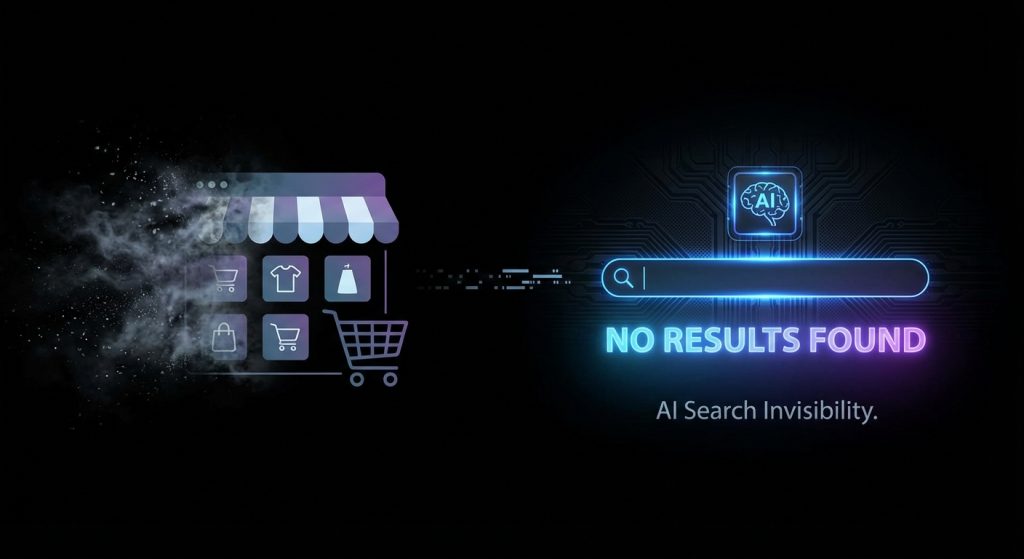
Many Shopify stores:
- Don’t have
llms.txt - Don’t control AI crawler access
- Don’t define live vs draft content boundaries
- Have no structured AI guidance
Some stores even risk:
⚠️ Draft products being scraped
⚠️ Unpublished collections exposed
⚠️ Developer notes leaking
⚠️ Test inventory getting indexed
Humans never see this.
LLMs can.
And AI systems don’t “understand intent” unless you structure it clearly.
Thin Product Pages = AI Ignored
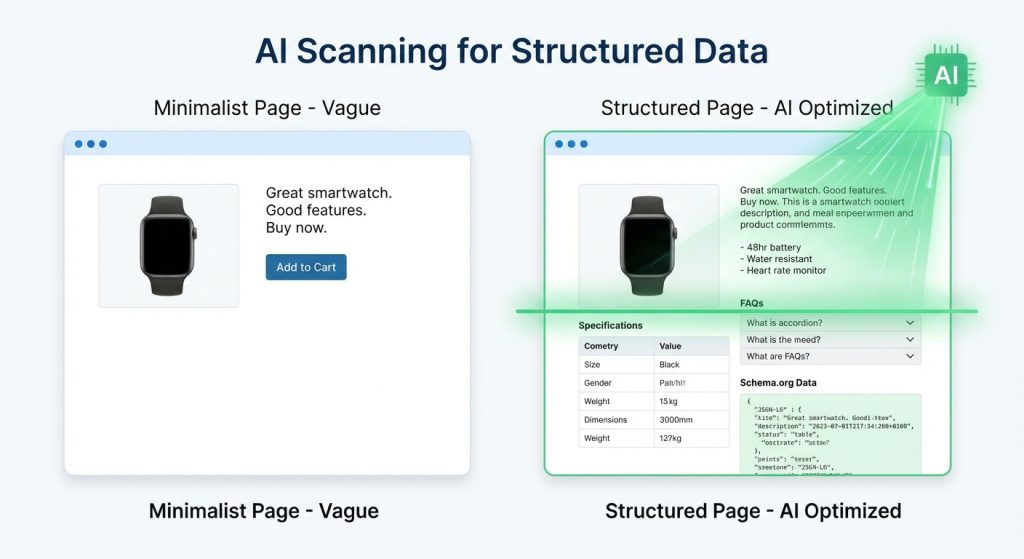
Humans can understand:
- Aesthetic branding
- Emotional messaging
- Visual cues
LLMs rely on:
- Clear product entities
- Structured attributes
- Descriptive paragraphs
- Lists and bullet points
- FAQ schema
- Consistent naming
Studies show:
📊 Pages using structured lists are cited 63% more often
📊 Adding Product + FAQ schema can improve citation probability by ~13%
If your product page says:
“Premium cotton t-shirt for everyday comfort.”
That’s not enough for AI.
It needs:
- Material
- Use case
- Target demographic
- Region
- Certifications
- Unique differentiators
- Structured FAQ
Humans Ignore Technical Layers. LLMs Depend on Them.
A human judges:
- Design
- Brand feel
- UX flow
- Trust badges
An LLM judges:
- Entity clarity
- Schema structure
- Semantic hierarchy
- Paragraph chunking
- List formatting
- Clean HTML
- Crawl instructions
You can have a stunning Shopify store…
And still be completely invisible in AI results.
What You Should Fix Immediately

1. Compare Rendered Page vs View Source
Right-click → View Page Source.
Check:
- Is your H1 visible in source?
- Is price visible in source?
- Are descriptions readable in HTML?
- Is FAQ present without JS?
If not — AI visibility is compromised.
2. Add Proper Schema Markup
At minimum:
- Product schema
- FAQPage schema
- Organization schema
- Breadcrumb schema
This helps LLMs extract:
- Product entities
- Price
- Availability
- Brand
- Reviews
Structured data = higher AI citation potential.
3. Implement llms.txt
LLMs don’t follow a strict global standard yet.
But llms.txt helps:
- Guide AI crawlers
- Define allowed sections
- Prevent scraping drafts
- Point to live data
- Control inventory exposure
Without it, AI guesses.
With it, you guide.
4. Write for AI Legibility
Structure content like this:
- Short paragraphs
- Clear H2/H3 hierarchy
- Bullet lists
- Feature breakdown
- Use cases
- Comparison blocks
- FAQs
AI prefers chunkable content.
Humans prefer scannable content.
Both win.
Why Traditional SEO Alone Is Not Enough
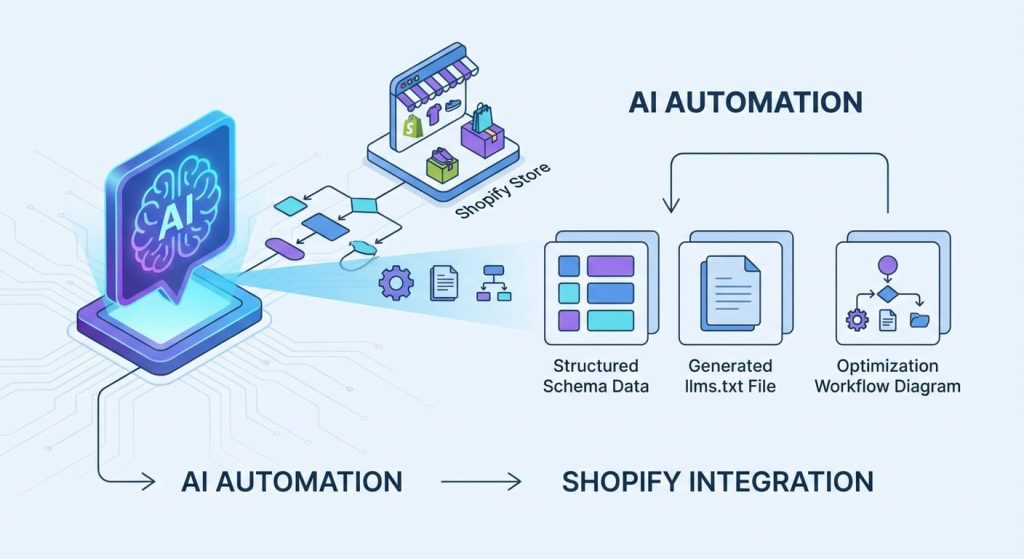
Traditional SEO focuses on:
- Keywords
- Backlinks
- Page speed
- Indexation
AI SEO focuses on:
- Entity clarity
- Structured extraction
- Citation probability
- Clean semantic HTML
- Controlled crawler access
If you only optimize for Google…
You miss ChatGPT, Gemini, and Perplexity traffic.
And AI-assisted shopping is growing rapidly.
The Shopify-Specific Solution: FSEO.ai
Most AI SEO advice online is generic.
Shopify needs platform-specific fixes.
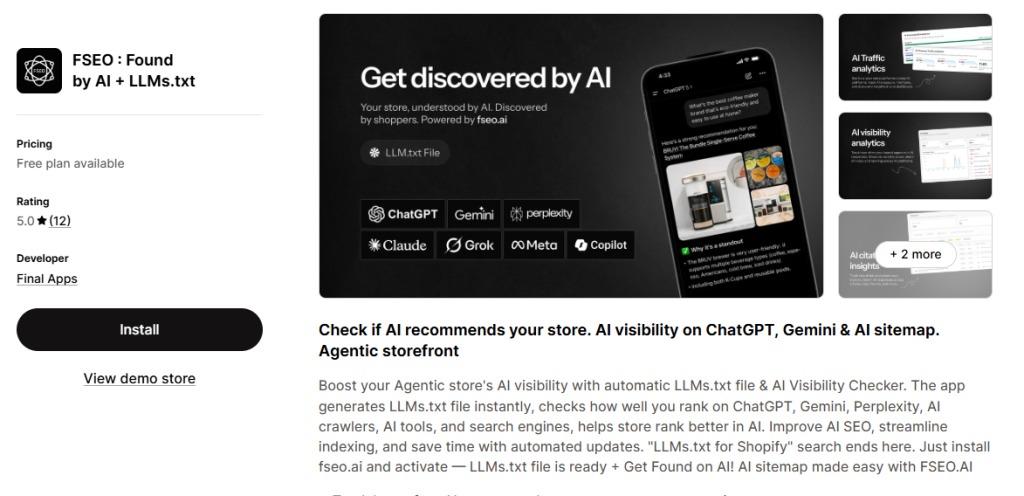
That’s where FSEO.ai by Final Apps comes in.
It helps Shopify stores:
- Automatically generate llms.txt
- Optimize Schema (Product, FAQ, Organization)
- Control crawler access
- Prevent draft exposure
- Improve AI citation visibility
- Track AI search visibility performance
- Structure content for AI chunking
- Monitor LLM indexing gaps
Instead of manual HTML edits…
FSEO automates AI readiness directly inside Shopify.
The New Reality: AI-Readable > Just Beautiful
In 2026:
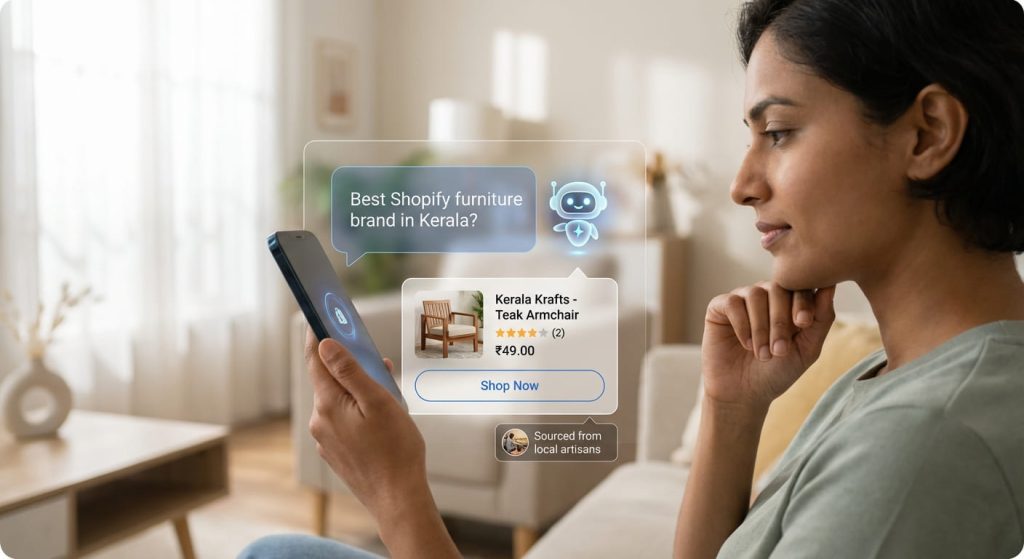
If AI can’t clearly read your store,
It can’t recommend your store.
And if AI doesn’t recommend you,
You lose qualified intent traffic.
Your Shopify store must now be:
- Human optimized
- Google optimized
- LLM optimized
Ignoring the third layer is the biggest visibility mistake merchants are making right now.
Final Takeaway
Humans see design.
LLMs see structure.
Humans click.
LLMs cite.
And in modern commerce – citations drive discovery.
If you want your Shopify store to show up when customers ask AI what to buy…
You need to optimize for what LLMs see, not just what humans see.